

Improving public services is never easy when citizens’ expectations are changing. For SME and organization managers in Belgium and Northern France, digitalization is becoming a central challenge for optimizing governance and accessibility. This article proposes concrete methods inspired by the latest French advances, with a focus on the systematic collection of data and user feedback, to help structure each stage of your digital transformation.
Table of contents
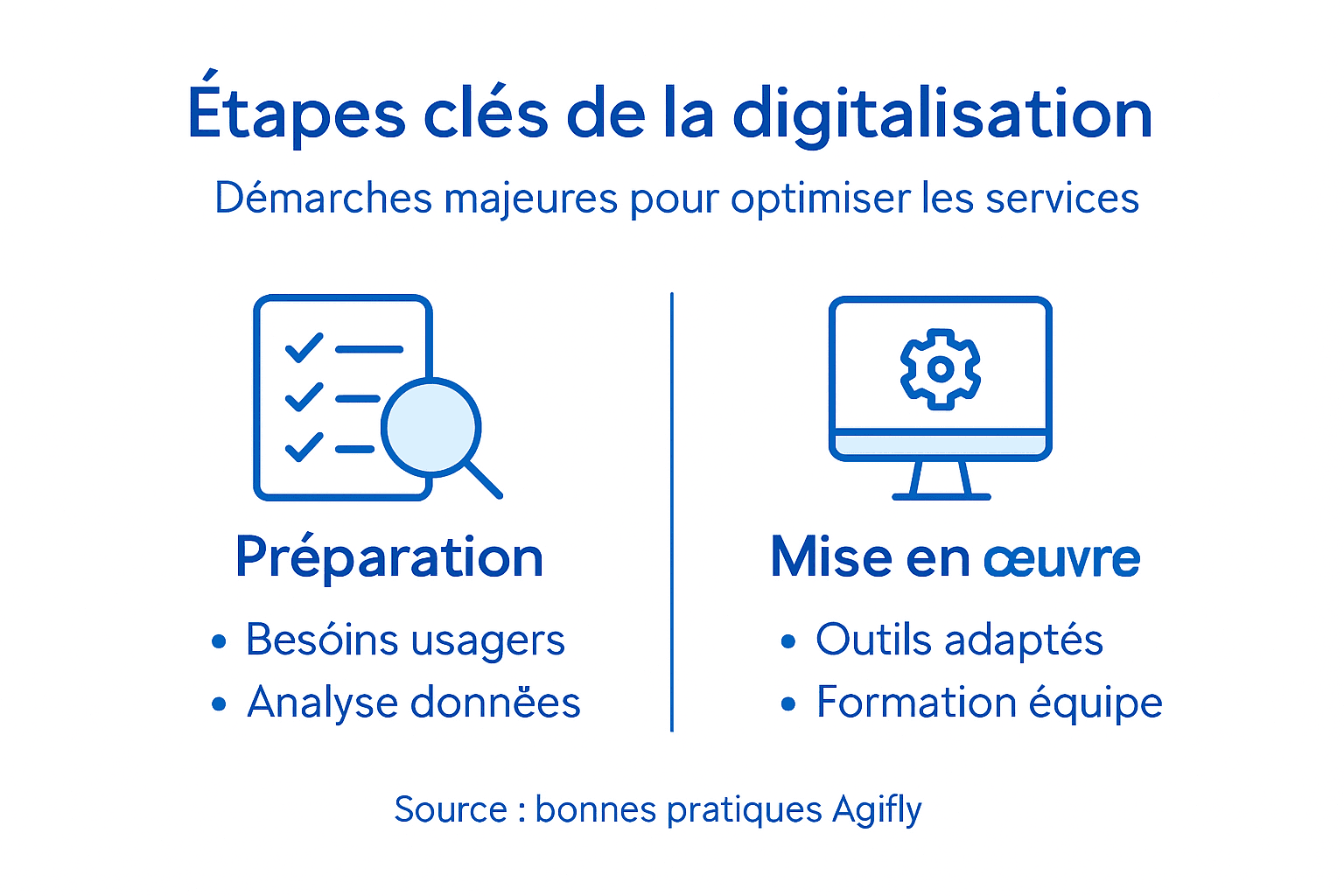
- Step 1: Analyze user needs and expectations
- Step 2: Draw up a customized digital roadmap
- Step 3: Choosing and integrating high-performance digital solutions
- Step 4: Train staff and support change
- Step 5: Test, measure and adjust digitalized services
Quick summary
| Key point | Explanation |
|---|---|
| 1. Analyze user needs | Understanding citizens’ expectations is vital to adapting public services. |
| 2. Draw up a digital roadmap | Defining strategic objectives and a timetable is essential for digital transformation. |
| 3. Choosing the right digital solutions | Security and scalability are crucial to successful integration. |
| 4. Train staff | Targeted training programs help support cultural change. |
| 5. Test and adjust services | Ongoing collection of user feedback enables us to proactively improve digitalized services. |
Step 1: Analyze user needs and expectations
Analyzing users’ needs and expectations is a crucial step in the digital transformation of public services. This approach enables us to understand exactly what citizens really want, and to adapt our services accordingly.
Several methods are essential for a successful analysis:
- Systematic data collection and user feedback
- Use of qualitative and quantitative survey techniques
- Analysis of public service satisfaction data
Data can be collected through a variety of channels: online surveys, individual interviews, focus groups and participative platforms. The aim is to gather precise insights into users’ experiences and frustrations.
Here’s an overview of the analysis methods used to understand users:
| Analysis method | Main advantages | Potential limitations |
|---|---|---|
| Online surveys | Fast, wide-ranging | Response bias, shallow |
| Individual interviews | Qualitative richness | High costs and time |
| Focus groups | Diversity of viewpoints | Difficulty of generalization |
| Participatory platforms | Continuous feedback | User engagement request |
Artificial intelligence now makes it possible to rapidly process and analyze large volumes of user feedback.
A methodological approach involves several steps:
- Define precise analysis objectives
- Selecting a representative sample
- Designing appropriate collection tools
- Process and analyze the data collected
- Turning insights into concrete recommendations
The analysis phase requires a rigorous approach that combines quantitative and qualitative methods. Numerical data is used to measure overall satisfaction, while qualitative feedback provides depth and context.
Pro tip: Invest in advanced analysis tools that enable you to process user feedback quickly and efficiently, focusing on a detailed understanding of real needs.
Step 2: Draw up a customized digital roadmap
Drawing up a digital roadmap is an essential strategic process for effectively transforming public services. It requires a methodical approach and a clear vision of digital transformation objectives.
To build a relevant roadmap, it is crucial to follow several key steps:
- Accurate digital diagnostics
- Define measurable strategic objectives
- Identify available resources and skills
Organizations need to understand the strategic axes of digital transformation, which involve several dimensions: technological, organizational and cultural.
Digital transformation is not just technical, but deeply human and collaborative.
An effective digital roadmap typically includes:
- An inventory of existing systems
- Precise, prioritized objectives
- An implementation schedule
- A provisional budget
- Performance indicators
The approach must emphasize strategic alignment and organizational agility. Each step must be based on real user needs and emerging technological possibilities.
This table summarizes the main points of a successful digital roadmap:
| Strategic focus | Organizational impact | Measurable objectives |
|---|---|---|
| Technological | Tool modernization | Reduction in processing time |
| Organizational | Process optimization | Better internal coordination |
| Cultural | Employee adoption | Increased commitment and satisfaction |
Pro tip: Involve your teams from the outset and create a collaborative dynamic to guarantee buy-in and the success of your digital transformation.
Step 3: Choosing and integrating high-performance digital solutions
Selecting and integrating high-performance digital solutions is a major strategic challenge for the digital transformation of public services. This step requires a methodical, well-thought-out approach to guarantee the effectiveness and relevance of digital tools.
For this integration to be successful, several fundamental criteria must be taken into account:
- Technical compatibility with existing systems
- Data security and information protection
- Scalability and adaptability of the solution
- Ease of use for agents and users
Organizations must respect the digital purchasing doctrine, which favors sobriety and digital sovereignty.
The performance of a digital solution is measured not only in terms of its technical features, but also in terms of its ability to meet users’ needs.
The selection and integration process involves several essential steps:
- Audit specific needs
- Identify market solutions
- Evaluating options
- Testing potential solutions
- Planning integration and migration
The approach must favor continuous adaptation and organizational learning. Each solution must be designed as a dynamic tool, capable of evolving as public services change.

Pro tip: Take a step-by-step approach to digital integration, starting with pilot projects to validate and adjust your strategy.
Step 4: Train staff and support change
Staff training and support are essential elements in the digital transformation of public services. This stage aims to develop individual and collective skills, while facilitating cultural and organizational adaptation.
There are several key strategies for making this transition a success:
- Identify specific training needs
- Create personalized development paths
- Promoting collaborative dynamics
- Developing a digital culture
Organizations can leverage learning communities to accelerate skills development.
Successful digital change is above all a human project, requiring listening, empathy and personalized support.
The support process has several dimensions:
- Diagnosis of current skills
- Defining a training plan
- Setting up support systems
- Ongoing monitoring and assessment
- Constantly adapting strategies
The approach must give priority to collective intelligence and individualized progress. Each agent must be seen as a player in his or her own professional transformation.
Pro tip: Create regular forums for dialogue and exchange, enabling agents to express their fears, expectations and proposals during the digital transformation.
Step 5: Test, measure and adjust digitalized services
Testing and measuring the performance of digitalized services is a crucial step in guaranteeing their effectiveness and continuous improvement. This phase enables us to check that the solutions we develop are in line with users’ real needs.
Organizations need to put in place a number of monitoring and evaluation mechanisms:
- Systematic collection of user feedback
- Analysis of performance indicators
- Performing user tests
- Measuring user experience
Public service barometers offer valuable tools for assessing overall satisfaction.
Measurement is not an end in itself, but a means of continuous improvement and constant adaptation.
The test and adjustment process comprises several fundamental steps:
- Define clear performance metrics
- Collect qualitative and quantitative data
- Analyze results in depth
- Identify areas for improvement
- Implement targeted adjustments
The approach must emphasize active listening and permanent adaptability. All user feedback must be seen as an opportunity for improvement.
Pro tip: Adopt an iterative approach where adjustments are made quickly and based on concrete data, involving users directly in the development process.
Optimize the digitalization of your public services with Agifly
Successfully digitizing public services requires a detailed understanding of user needs and an agile transformation that integrates high-performance digital solutions. Are you looking to modernize your tools while ensuring a seamless experience for your agents and citizens? Our expertise in Smart Design and scalable development will support you at every stage of your project.
Explore how our expertise can support the implementation of your digital roadmap by visiting our dedicated category Item 1 Archives – Agifly. Don’t let technological challenges hold back your transformation: benefit now from a reliable partnership that grows with your ambitions. Discover all our solutions on Agifly and launch your project towards excellence.