

Thinking that UX design boils down to visual aesthetics remains one of the biggest pitfalls for many SMEs. For marketing directors and digital project managers in Belgium, adopting a user-oriented approach is now essential to stand out from the crowd and meet real customer expectations. Discover how an approach based on simplicity and understanding of user needs can optimize your digital solutions and increase conversion.
Table of contents
Key points
| Point | Details |
| Importance of UX Design | UX design goes beyond aesthetics, it’s about optimizing user interaction to create intuitive and effective experiences. |
| Differences between UX and UI | Understanding the differences between UX and UI is essential to ensure consistency between experience and interface. |
| Iterative process | A rigorous UX process includes research, analysis, design and validation phases to guarantee the quality of the final product. |
| Avoiding common mistakes | Identifying and avoiding pitfalls such as neglected user research and overloaded interfaces is crucial to design success. |
Definition of UX design and preconceived ideas
UX design is much more than just visual design. It’s a strategic, user-centered approach to optimizing the interaction between an individual and a digital product. The full definition of UX design encompasses a methodical process that goes beyond mere aesthetics.
Contrary to popular belief, UX design is not just about graphic beauty, but also about efficiency and understanding. The main confusions persist around several myths:
-
UX design is not the same as graphic design
-
Visual beauty does not equal good user experience
-
More features don’t mean more satisfaction
The fundamental principles of UX design rest on several essential pillars:
-
Really understand user needs
-
Simplify navigation paths
-
Reducing cognitive load
-
Guaranteeing accessibility
-
Continuous measurement and optimization
The main objective remains to create interfaces that are intuitive and efficient, where each element has a precise meaning and function. UX design methods involve in-depth research, user testing and continuous improvement.
Successful UX design responds to users’ needs even before they explicitly formulate them.
Pro tip: Invest in regular user testing to really understand how your users interact with your digital interface.
UX and UI differences: not to be confused
Although often used interchangeably, UX (User Experience) and UI (User Interface) are two distinct but complementary concepts in digital design. Understanding their differences is essential to creating effective digital products.
The main distinctions between UX and UI can be summarized as follows:
-
UX Design: Focusing on overall experience and interaction
-
UI Design: Focusing on visual appearance and aesthetics
-
UX refers to usefulness and ease of use
-
UI deals with appearance and presentation
A simple way to differentiate between these two areas:
-
UX determines path and logic
-
UI dresses and shapes this journey
-
UX solves interaction problems
-
UI creates the visual appearance of these solutions
The UX designer works like an architect: planning the structure, organization and flow of the experience. The UI designer acts like an interior decorator: choosing the colors, fonts and visual elements that will make the interface attractive and coherent.
Here is a summary of the key differences between UX and UI to help guide your projects:
| Aspect analyzed | UX Design | UI Design |
| Main objective | Optimize the overall user experience | Improve the visual appeal of the interface |
| Focus | User: needs and expectations | Interface: aesthetics and ergonomics |
| Key questions | Why does the user perform an action? | How does this action appear visually? |
| Role in the project | Architect of the path and interactions | Decorator of the graphic presentation |
The UX defines the soul of the product, the UI gives it its face.
Pro tip: Always remember to integrate your UX and UI designers from the very start of a project to guarantee perfect consistency between the experience and the interface.
UX design process: from research to testing
The UX design process is a methodological and iterative approach that transforms user needs into powerful digital experiences. Design involves several crucial steps that guarantee the quality and effectiveness of the final product.
The main phases of the UX design process can be broken down as follows:
-
User research: Understanding real needs
-
Data analysis: Identifying insights
-
Creating personas: Representing typical users
-
Prototyping: Materialising the first solutions
-
Testing and validation: Evaluating experience
Let’s look at each step of the process in detail:
-
Research phase
-
Qualitative interviews
-
User path analysis
-
Behavioral studies
-
-
Design phase
-
Defining user flows
-
Creating wireframes
-
Interface design
-
-
Validation phase
-
User tests
-
Collecting feedback
-
Iterative adjustments
-
Each step requires meticulous attention and a user-centered approach. The UX designer must constantly juggle empathy, creativity and rational analysis.
The quality of a user experience is measured by its ability to solve a problem simply and efficiently.
Pro tip: Systematically document every design decision with concrete data to justify your choices to stakeholders.

Applying UX design to SME solutions
IntegratingUX design into the digital solutions of Belgian SMEs now represents a crucial strategic lever for competitiveness. The digital transformation of organizations is enabling companies to rethink their approaches and significantly improve their interaction with customers.
The concrete benefits of UX design for SMEs include :
-
Improving customer satisfaction
-
Lower development costs
-
Optimizing internal processes
-
Increase in conversion rate
-
Market differentiation
A methodical approach to UX design involves several key steps:
-
Understanding users’ real needs
-
Mapping customer paths
-
Prototype adapted solutions
-
Continuous testing and iteration
-
Measuring impact
Every digital solution must be designed as a precise response to a specific user need. The UX designer acts as a translator, transforming complex issues into intuitive, effective interfaces.
UX design is not a cost, but a strategic investment in SME growth.
Pro tip: Carry out regular user tests with a small representative group to validate your design hypotheses at lower cost.
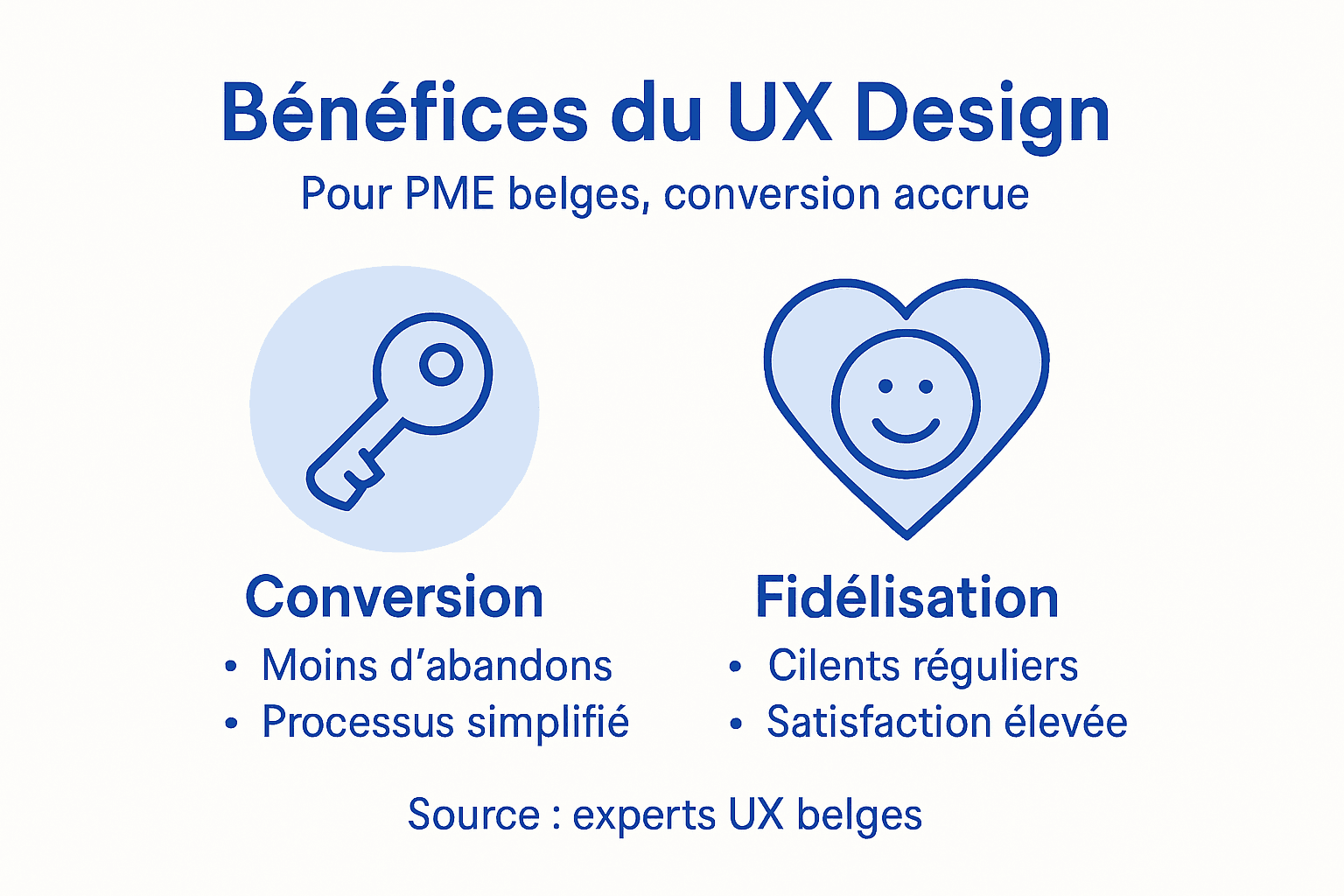
Benefits: conversion, loyalty, differentiation
UX design is a major strategic lever for Belgian SMEs, offering much more than just aesthetic enhancement. Intelligent design and scalable development enable companies to radically transform their digital approach and business performance.
The key benefits of UX design can be categorized into three main areas:
-
Conversion: Increase conversion rates
-
Loyalty: Improving the customer experience
-
Differentiation: Unique competitive positioning
Let’s look at each benefit in detail:
-
Conversion
-
Optimized user experience
-
Reducing dropouts
-
Simplified purchasing process
-
-
Loyalty
-
Smooth user experience
-
Personalized interactions
-
Meeting implicit expectations
-
-
Differentiation
-
Innovative design
-
User-centered approach
-
Perceptible added value
-
Every design decision has a direct impact on user perception and behavior. UX design acts as a silent translator, transforming commercial intentions into memorable experiences.
Successful UX design isn’t something you notice, it’s something you feel.
Pro tip: Invest in precise user behavior metrics to measure the real impact of your UX improvements.
Common pitfalls and mistakes to avoid
UX design conceals many subtle pitfalls that Belgian SMEs must identify and avoid. In-depth user research is the first line of defense against these potentially costly pitfalls.
The main pitfalls to avoid include :
-
Neglecting the user research phase
-
Overloading the interface with too many options
-
Ignoring user feedback
-
Blindly copying design trends
-
Underestimating the complexity of the user experience
A detailed analysis of these common mistakes:
-
Insufficient user research
-
No personas
-
No user tests
-
Unvalidated assumptions
-
-
Cognitive overload
-
Too many features
-
Complex interfaces
-
Confusing navigation
-
-
Non-user-centered design
-
Aesthetics first
-
Ignorance of real needs
-
Lack of empathy
-
Every design decision must be guided by an in-depth understanding of user behavior and expectations. The effective UX designer acts as a translator between business intentions and user needs.
This table summarizes the main pitfalls to avoid and how to prevent them in UX design:
| Frequent mistakes | Real consequences | Recommended good practice |
| Neglected user research | Product not adapted to needs | Conduct early interviews and tests |
| Overly complex interface | User confusion and abandonment | Prioritize and simplify options |
| Trend copied without adaptation | Irrelevant design for your customers | Adapt each choice to the SME context |
The best interfaces are the ones you don’t notice, but which work perfectly.
Pro tip: Systematically carry out user tests at each design stage to validate your design hypotheses.
Transform your customers’ experience with UX Design
Would you like to increase the conversion and loyalty of your Belgian SME by offering a fluid, tailored user experience? The article “UX Design: Key to Conversion for Belgian SMEs” shows that a deep understanding of user needs and the optimization of user journeys are essential elements for effective differentiation in the competitive marketplace. At Agifly, we’re committed to supporting your digital growth with intelligent design and scalable development perfectly adapted to your needs.
Find out now how Agifly can become your trusted partner for building interfaces that convert and build loyalty over time. Don’t lose any more customers through a poorly thought-out experience. Take action today.
Frequently asked questions
What is UX design?
UX design is a strategic, user-centered approach that optimizes the interaction between an individual and a digital product, going beyond aesthetics to focus on efficiency and understanding.
How can UX design improve conversion for SMEs?
UX design helps optimize the user journey, reduce abandonment and simplify the purchasing process, all of which contribute to higher conversion rates.
What are the key stages in the UX design process?
The main steps include user research, data analysis, creation of personas, prototyping, and testing and validation to evaluate the user experience.
What are the common UX design pitfalls to avoid?
Pitfalls include neglecting user research, overloading the interface with too many options, ignoring user feedback, and the tendency to copy designs without adapting them to the specific context of users.