

Trying to make your company more flexible in the face of market uncertainty has become a common challenge for many digital managers in Belgium and northern France. Digital agility isn’t just about integrating new technologies, it’s also about profoundly transforming corporate culture and strengthening the company’s capacity for innovation. This article offers you concrete keys to masteringdigital agility and delivering sustainable, adaptive performance for your SME.
Table of contents
- Defining digital agility in business
- Main types and models of digital agility
- Key benefits for SME performance
- Success factors and common mistakes to avoid
- Digital agility and security for digital solutions
Key findings
| Point | Details |
| Digital agility | Digital agility goes beyond the technological, transforming corporate culture and fostering flexibility and innovation. |
| Agility models | Several models, such as SAFe and Spotify, help to structure agility. Each company must choose the one that best suits its context. |
| Benefits for SMEs | Digital agility enables SMEs to improve their performance and responsiveness, and optimize their internal processes to stay competitive. |
| Digital Security | Integrating digital security is essential for SMEs; it requires a proactive and continuous approach in the face of growing threats. |
Defining digital agility in business
Digital agility represents a profound strategic transformation for modern businesses, far beyond a simple technological change. It represents a global approach that reinvents organizational modes of operation with maximum flexibility and responsiveness.
This approach is based on several fundamental principles that redefine corporate culture:
- Continuous adaptation to market changes
- Cross-functional collaboration between departments and teams
- Rapid integration of emerging technologies
- Customer-centric approach
Digital agility has its roots in the software development methods of the 1990s, but has rapidly spread to all areas of the company. It is characterized by the ability to transform constraints into opportunities for innovation and growth.
Companies that master digital agility develop a real capacity for resilience in the face of technological and economic change. They know how to deconstruct traditional organizational silos to create more dynamic, interconnected work environments.
Digital agility is not a state, but an ongoing process of adaptation and transformation.
Pro tip: Start by carrying out a precise diagnosis of your digital maturity before launching any organizational transformation.
Main types and models of digital agility
Today, digital agility is expressed through a number of structured models that enable companies to transform their strategic approach. Digital maturity models provide a precise framework for understanding and managing this digital transformation.
The main models include :
- Scaled Agile Framework (SAFe): agility at scale for large organizations
- CMMI maturity model: a step-by-step approach
- Spotify model: start-up organization and autonomous squads
- DevOps: continuous integration between development and operations
The Scaled Agile Framework (SAFe) is a particularly advanced reference, integrating Lean, Agile and DevOps principles to promote strategic alignment and continuous process improvement.
Each model has specific features adapted to different organizational contexts, enabling companies to choose the most appropriate approach according to their size, sector and technological maturity.
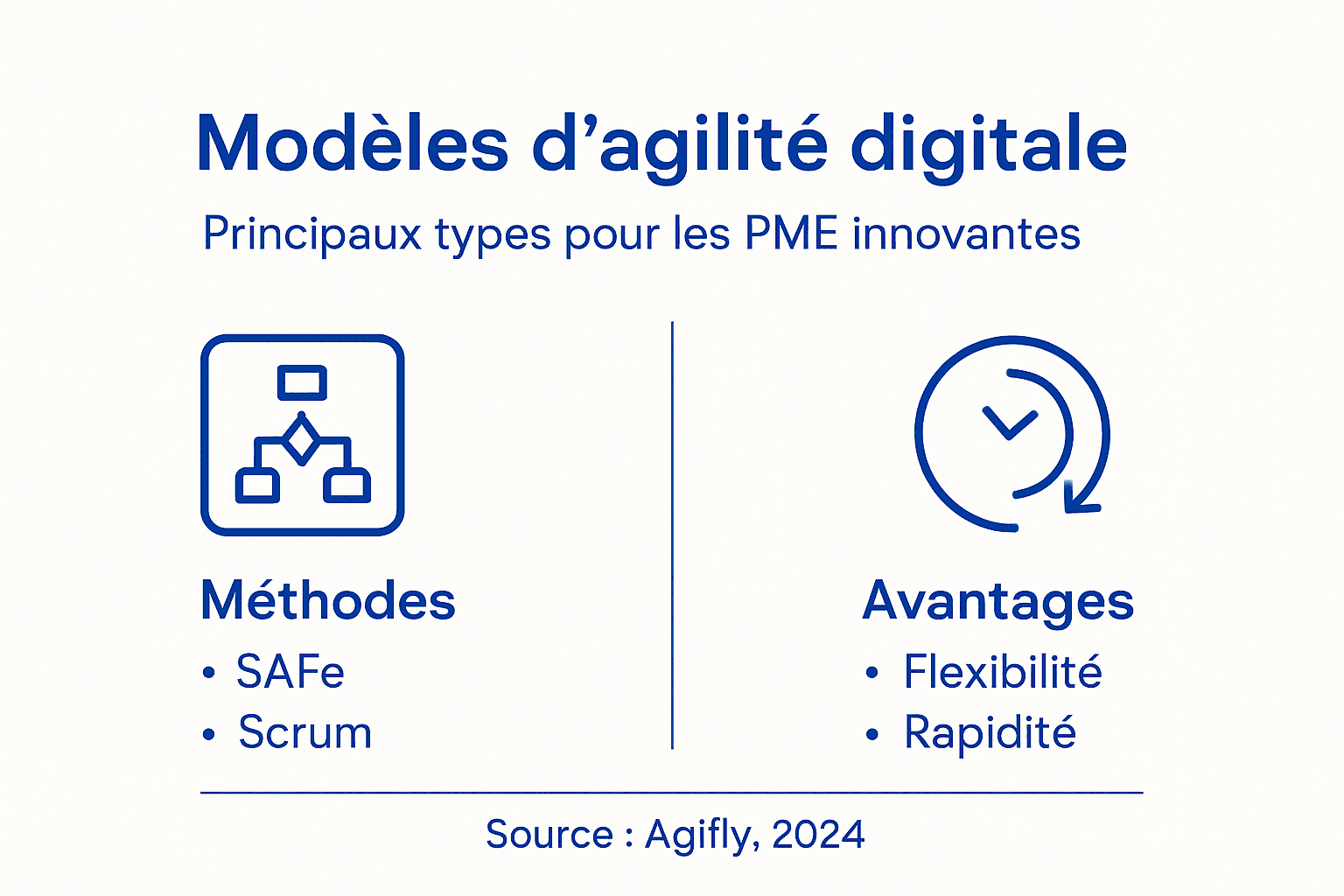
Here’s a comparative overview of the main digital agility models:
| Model | Main purpose | Adaptability | Preferred sector |
| SAFe | Large-scale coordination | High | Large-scale companies |
| CMMI | Progression by level | Average | IT, industry |
| Spotify | Team autonomy | High | Start-ups, PME tech |
| DevOps | Development/production merger | Strong | Digital, services |
The key lies in the ability to adapt the model to your own organizational reality, rather than blindly following it.
Pro tip: Make a precise diagnosis of your ecosystem before choosing an agility model, assessing your internal constraints and corporate culture.
Key benefits for SME performance
Digital transformation offers SMEs a major strategic opportunity to significantly boost their performance through continuous innovation and optimization mechanisms. This approach enables small and medium-sized businesses to become more competitive in an increasingly dynamic economic environment.
The main benefits of digital agility for SMEs include:
- Shorter time -to-market
- Improved customer responsiveness
- Optimizing internal processes
- Development of continuous innovation
- Greater organizational flexibility
Organizational agility profoundly transforms the way SMEs manage their projects and resources. It enables the development of a more adaptable corporate culture, where innovation becomes a natural, ongoing process rather than a one-off event.
Each stage of digital transformation represents a strategic opportunity for differentiation, enabling SMEs to respond more rapidly to market changes and customer expectations.
Digital agility is not a cost, but an investment in a company’s ability to adapt and grow.
Pro tip: Start your digital transformation with a precise diagnosis of your current processes, identifying the areas most critical to your performance.
Success factors and common mistakes to avoid
Digital transformation in SMEs requires a rigorous strategic approach, in which management commitment plays a crucial role. Understanding the success factors and pitfalls to be avoided is essential to the success of this organizational transformation.
Key success factors include :
- Strategic alignment with corporate objectives
- A culture of innovation and continuous learning
- Enhancing team skills
- Transparent communication
- Organizational flexibility
To avoid the classic pitfalls, SMEs need to be particularly vigilant in a number of areas. Resistance to change, rigid hierarchical structures and a lack of long-term vision are major obstacles to digital transformation.
The most common mistakes to prevent are :
- Underestimating training needs
- Neglecting human support
- Multiplying initiatives without coherence
- Ignoring employee feedback
Successful digital transformation depends more on adaptability than technical perfection.
Pro tip: Create a cross-functional transformation committee involving representatives from all departments to ensure collective ownership of the change.
Digital agility and security for digital solutions
The digital transformation of SMEs now requires the strategic integration of digital security, where risk governance becomes a central issue. Agile digital solutions must proactively and intelligently combine innovation and data protection.
The critical dimensions of digital security include :
- Protecting digital infrastructures
- Access and identity management
- Encryption of sensitive data
- Real-time threat monitoring
- Resilience to cyber-attacks
SMEs now need to view security as a dynamic process, rather than a static constraint. This approach implies constant vigilance, regular updates and an integrated cybersecurity culture at all levels of the organization.
The main areas for securing digital solutions are :
To illustrate the impact of digital agility on security, here’s a summary of strategic actions to prioritize:
| Safety dimension | Key action | Impact on the company |
| Governance | Regular audits | Proactive risk detection |
| Training | Continuous awareness | Reducing human incidents |
| Technology | Advanced encryption | Protection of sensitive information |
| Procedures | Response plan | Damage limitation in the event of an attack |
- Carry out regular safety audits
- Systematic employee training
- Implement incident response protocols
- Adopt advanced protection technologies
Digital security is not a state, but a process of continuous improvement.
Pro Tip: Invest in a digital risk management system that is flexible and able to adapt quickly to new technological threats