

A fast website is no longer enough to attract and retain customers in Belgium or Northern France. Reality shows that every second less it takes to load a site can reduce conversions by 7%, and by up to 20% on mobile devices. Understanding and overcoming preconceived ideas about web performance is therefore becoming a strategic challenge, in order to transform the user experience into a competitive advantage and maximize the benefits of local and national SEO.
Table of contents
- Defining web performance and misconceptions
- Key indicators: speed, ux, seo
- Direct impact on local and national seo
- Impact on conversion and customer loyalty
- Common obstacles and solutions for SMEs
Key points
| Point | Details |
| The importance of performance | Web performance directly influences user experience and business results. |
| Myths to deconstruct | Loading speed is just one aspect; other factors such as user experience and content quality are crucial. |
| Recommended Regular Audits | An audit of your site every 6 months or quarterly allows you to proactively identify and correct performance problems. |
| Local SEO strategies | Optimizing local SEO is essential to improving visibility; focus on consistency of information and geolocalized content. |
Defining web performance and misconceptions
Web performance is not simply a question of loading speed, but a complex strategy that directly impacts user experience and business results. In today’s ultra-competitive digital world, understanding what’s really at stake is crucial for companies wishing to stand out from the crowd.
Many myths persist around web performance, preventing digital managers from implementing effective strategies. Web architectures are evolving rapidly, with the emergence of new technologies transforming our traditional understanding of performance.
Here are the main misconceptions to deconstruct:
- Loading speed: Not the only performance indicator
- Design: A fast site is not necessarily well designed
- Content: Quality over quantity
- Mobile first: A technical and strategic approach, not just a display format
In reality, web performance covers several interconnected dimensions:
- Technical performance (loading time)
- User experience (ease of navigation)
- SEO optimization
- Conversion and engagement
- Accessibility and responsive design
Key metrics to monitor include initial load time, responsiveness, visual stability and interaction. These indicators accurately measure the actual user experience.
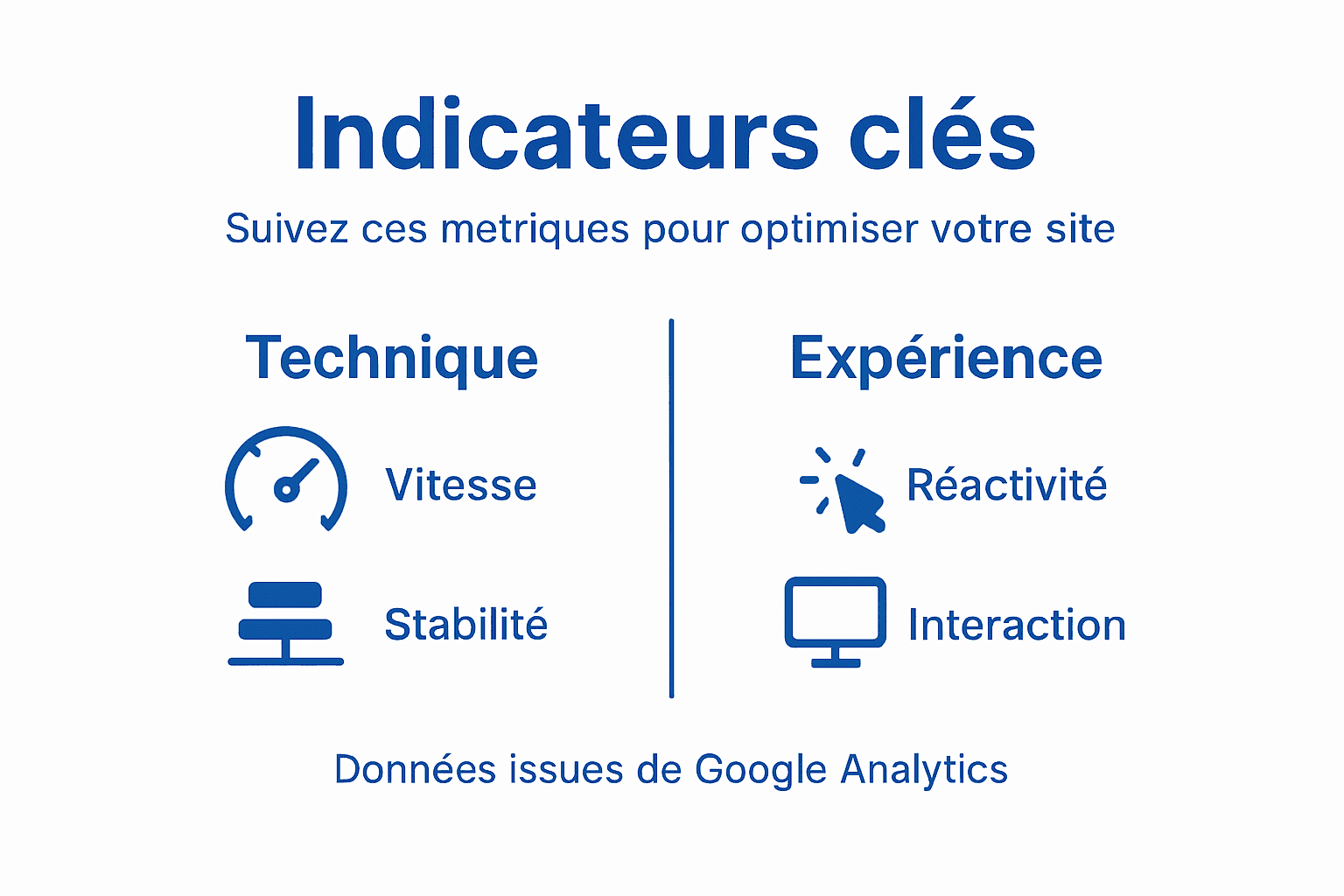
Here’s a comparative overview of the major web performance indicators and their impact on the company:
| Key indicator | Impact on user | Contribution to business objectives |
| Loading time | Reduced frustration | Increased conversion rate |
| Visual stability | Better navigation | Reduced cart abandonment |
| Mobile optimization | Seamless mobile experience | Growth in recurring mobile traffic |
| Content quality | Clear information | Enhanced brand image |
Web performance is not a state, but a process of continuous improvement.
Pro tip: Carry out a full audit of your website every 6 months to proactively identify and correct performance problems.
Key indicators: speed, UX, SEO
Web performance rests on three fundamental, interdependent pillars: speed, user experience (UX) and search engine optimization (SEO). These indicators are not simply technical metrics, but strategic levers that determine a company’s digital success.
Loading speed is the first crucial criterion. A website that takes too long to load will immediately lose visitors’ attention. Optimization strategies require a precise technical approach, combining image compression, caching and code minimization.
Theuser experience goes far beyond mere speed:
- Intuitive navigation
- Responsive design
- Accessibility on all media
- Smooth user experience
- Relevant, easy-to-read content
SEO involves several strategic dimensions:
- Technical optimization of the site
- Quality and relevance of content
- Semantic page structure
- Internal and external links
- Mobile performance
Web performance is not a static objective, but a continuous improvement process that requires constant monitoring.
Key metrics to monitor include :
- Initial loading time
- Visual stability
- Primary interaction
- Response time
- Bounce rate
Pro tip: Carry out a full web performance audit every quarter to proactively identify and correct potential problems.
Direct impact on local and national SEO
Today, local SEO represents a crucial strategic lever for companies seeking to maximize their digital visibility. Geographical optimization practices make it possible to precisely target regional and national audiences with formidable efficiency.
Local SEO strategies are based on several essential pillars:
- Optimizing Google Business profiles
- Consistency of NAP information (Name, Address, Phone)
- Proactive management of customer reviews
- Relevant, geolocalized content
- Local links and citations
Key local SEO performance indicators include :
- Ranking in local results
- Specific traffic by region
- Conversion rates from local searches
- Online reputation and authority score
- Engaging users with local content
Local SEO is not just a marketing technique, but a real strategy for territorial positioning.
Companies need to understand that local SEO differs significantly from national SEO. It requires a more granular approach, focused on territorial specificities and local search behavior.
For a better understanding of alternative SEO strategies depending on the context, here is a table comparing local SEO versus national SEO:
| Aspect | Local SEO | National SEO |
| Primary targeting | Specific geographical areas | National or international reach |
| Objective | Increase regional visibility | Increase global awareness |
| Major tools | Google Business, customer reviews | External links, domain authority |
| Content method | Geolocated pages, ads | Articles, specialized landing pages |
Pro tip: Invest in hyperlocal content creation and maintain absolute consistency of your information across all online directories.
Impact on conversion and customer loyalty
Web performance is a decisive strategic lever for improving conversion and building long-term customer loyalty. Web performance metrics reveal that a precise technical approach can radically transform business results.
The impact on conversion can be measured on several levels:
- Reduced bounce rate
- Improved user experience
- Increased customer confidence
- Optimizing calls to action
- Personalized experience
The figures speak for themselves:
- A one-second drop in loading time can reduce conversions by 7%.
- On cell phones, the drop can be as much as 20%.
- A high-performance site significantly reduces cart abandonment
- Visual stability increases engagement
- Rapid interactivity builds trust
Conversion is not a one-off event, but a process of continuous experience.
Loyalty strategies now depend on a flawless digital experience, where every millisecond counts. Web performance is becoming a real competitive differentiator.

Pro tip: Invest in precise user experience measurement tools and carry out regular tests to continually optimize your web performance.
Common obstacles and solutions for SMEs
SMEs face complex challenges in optimizing their web and SEO performance. Local SEO strategies require a methodical approach tailored to their limited resources.
The main obstacles encountered by SMEs include :
- Lack of dedicated technical resources
- Limited marketing budget
- Complexity of SEO tools
- Inadequate management of online profiles
- Difficulties in generating customer reviews
Practical bypass strategies :
- Standardize NAP information (Name, Address, Phone)
- Use online reputation management tools
- Develop opinion-gathering campaigns
- Invest in in-house SEO training
- Automate certain marketing tasks
Web optimization is not a cost, but a strategic investment for SMEs.
Technological solutions can significantly reduce complexity. The gradual adoption of integrated platforms enables SMEs to professionalize their digital presence without massive investment.
Pro tip: Start with a minimal SEO audit and focus on 2-3 priority improvements rather than trying to transform everything simultaneously.
Improve your web performance to boost SEO and conversion
Web performance is at the heart of today’s challenges for any company wishing to optimize its SEO and increase its conversion rates. The real challenge is not just loading speed, but also user experience, visual stability and appropriate mobile optimization. If you’re having trouble converting your traffic into customers, or ranking clearly in local and national results, now’s the time to act.
Discover how our approach combines intuitive design and scalable development to create high-performance digital solutions. Our experts analyze your key indicators and implement a customized strategy to improve your SEO and build customer loyalty. For a more in-depth approach, start with a full audit to identify priority areas for improvement.
Don’t let web performance hold you back. With Agifly, you’ll benefit from tailor-made support that evolves with your needs. Explore our powerful development and reliable hosting offerings to guarantee an optimal user experience. Contact us today to transform your site into a powerful business lever.