

Designing a website that keeps pace with the growth of your SME is never a simple formality. Expectations evolve, competition intensifies, and every technical decision has a direct impact on conversion and follow-up. To succeed in the Northern France market, it’s essential to set up a structured website architecture, capable of anticipating your future needs and offering your users a truly intuitive experience.
Table of contents
- Step 1: Define business objectives and needs
- Step 2: Structuring architecture and user experience
- Step 3: Choosing the right, scalable technologies
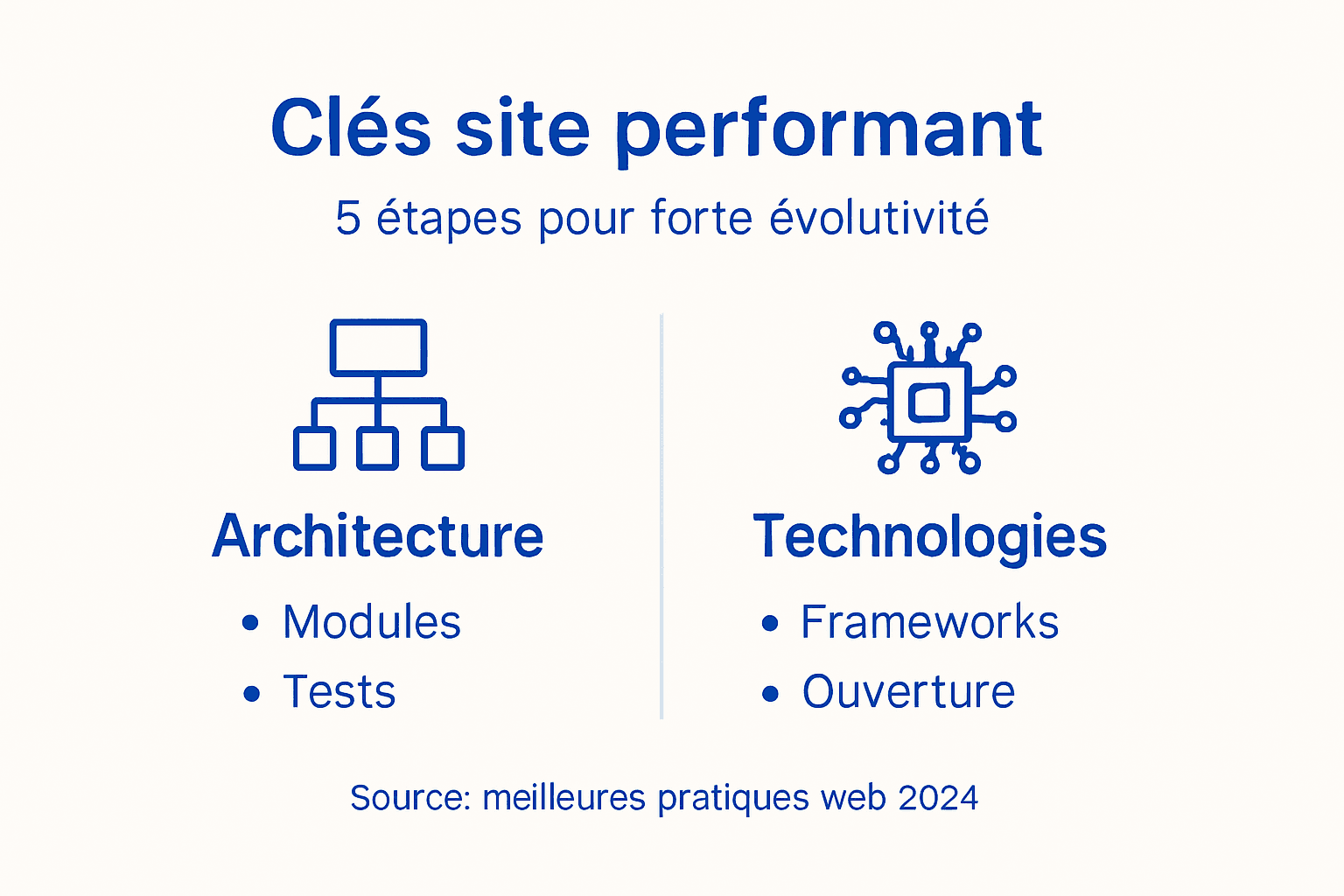
- Step 4: Modular site design and development
- Step 5: Test functionality and measure performance
Quick summary
| Key point | Explanation |
| 1. Define SMART objectives | Objectives must be specific, measurable, achievable, realistic and timed to guide the project. |
| 2. Inter-departmental collaboration | Involving all the company’s departments ensures a comprehensive view of needs and expectations. |
| 3. The importance of modular architecture | A modular structure facilitates site maintenance and evolution by enabling agile updates. |
| 4. Regular performance testing | Iterative testing is essential to ensure optimal user experience and to detect problems. |
| 5. Document each step for follow-up | Documenting objectives and modules helps to track progress and ensure consistency throughout the project. |
Step 1: Define business objectives and needs
The precise definition of business objectives and requirements is the foundation of every successful web project. This crucial phase translates your company’s strategic ambitions into concrete technical specifications that will guide the entire development process.
To succeed in this step, you need to carry out a systematic, multi-dimensional analysis. Start by identifying the expected business results: increased conversions, reduced costs, improved customer experience. Each objective must be SMART (Specific, Measurable, Achievable, Realistic and Time-bound).
Here are the main dimensions to explore:
- Business objectives: Sales growth, conquest of new markets
- Expected performance: loading time, conversion rate, number of visits
- User experience: Intuitive navigation, responsive design, accessibility
- Technical integrations: Connection with existing systems, software architecture design
A collaborative approach is essential. Involve the company’s various departments – marketing, sales, technical – to get a 360-degree view. Each department will bring unique perspectives on needs and expectations.
Here’s an overview of the business impacts associated with each key dimension when defining objectives.
| Dimension analyzed | Impact on the company | Tracking metric |
| Business objectives | Contribute to growth and profitability | Revenues and new customers |
| Expected performance | Promotes engagement and loyalty | Conversion rate, loading time |
| User experience | Reduces abandonment, improves satisfaction | NPS, session duration |
| Technical integrations | Optimize internal processes | Number of successful integrations |
A poorly defined objective condemns the project to failure before it even gets off the ground.
Pro tip: Document each objective with precise indicators and measurable metrics to effectively track the progress of your web project.
Step 2: Structuring architecture and user experience
The structuring of web architecture and user experience is a key strategic element in the performance and appeal of your site. It’s all about creating a digital environment that intuitively guides your visitors towards their objectives, while facilitating their journey.
Information architecture must meet several fundamental principles. It requires a clear, logical organization that anticipates user needs and expectations. Essential components include :
- Intuitive navigation: simple, hierarchical menus
- Accessibility: Smooth flow between sections
- Prioritization: Visual organization of content
- Graphic consistency: harmonious, responsive design
To achieve this structuring, focus on creating effective user paths. Each page should be thought of as a step in an overall journey, with clear calls to action and natural transitions. The aim is to minimize friction and maximize engagement.
Well-designed architecture turns visitors into active users.
Pro tip : Carry out regular user tests to validate and continuously optimize your website’s navigation and experience.
Step 3: Choosing the right, scalable technologies
Technology selection is a crucial stage in the design of a high-performance, scalable website. Your choice of technology must not only meet your company’s current needs, but also anticipate future developments and changes.
Today, new-generation web technologies offer remarkable possibilities in terms of performance and scalability. Selection criteria must integrate several strategic dimensions:
- Compatibility: Interoperability with existing systems
- Scalability: Ability to scale up quickly
- Performance: Execution speed and response time
- Security: Robustness against potential threats
- Maintainability: Easy to update and adapt
Modern frameworks such as React, Vue and WebAssembly-based architectures enable the development of highly dynamic and responsive web applications. The aim is to create a flexible technological infrastructure that adapts naturally to your company’s growth.

To better understand the technological evolution, here’s a comparison of the main modern frameworks.
| Framework | Highlights | Typical use |
| React | Highly responsive, large community | Interactive applications |
| View | Simplicity, flexibility | Scalable projects or prototypes |
| WebAssembly | Performance, independence | Data-intensive processing |
Technology is not an end in itself, but a means to transform your digital ambitions into operational reality.
Pro tip: Always opt for open, standardized technological solutions that will enable you to maintain your strategic agility.
Step 4: Modular site design and development
Modular design is an essential strategic approach to creating a scalable, adaptable website. This method allows you to build your digital infrastructure as a set of independent but interconnected components, offering maximum flexibility.
Modular architecture transforms your website into an agile technological ecosystem. The key principles of this approach are :
- Independence: each module can be developed, tested and modified separately
- Reusability: components can be reused in different contexts
- Scalability: modules can be easily added or replaced
- Maintainability: Simplified updates and corrections
To implement this strategy effectively, divide your site into coherent functional blocks. Each block should have a single, clearly defined responsibility, such as user management, the payment system or the search interface.
A modular site is comparable to a modular building system, where each element can be adjusted without disturbing the whole structure.
Pro tip: Rigorously document the interface of each module to facilitate its integration and future maintenance.
Step 5: Test functionality and measure performance
The testing and performance measurement phase is the crucial step in validating the quality and effectiveness of your website. This stage will guarantee an optimal user experience and identify any areas for improvement.
Use tools like PageSpeed Insights to accurately assess your site’s technical performance. The dimensions to explore are :
- Loading speed: time required for full display
- Responsiveness: smooth user interaction
- Multi-device compatibility: Operation on different media
- Accessibility: Navigation for all users
- Security: Protection against potential vulnerabilities
Remember to carry out exhaustive tests covering critical user scenarios. Simulate different paths, check the robustness of functionalities and measure response times on several configurations.
Technical performance has a direct impact on user satisfaction and loyalty.
Pro tip: Perform regular, iterative tests, as performance can gradually deteriorate with updates.
Give life to a scalable, high-performance website today
Designing a website that grows with your company requires a mastery of issues such as clearly defining business objectives, modular structuring and judicious choice of technologies. At Agifly, we understand these crucial challenges and work with you to transform your digital ambitions into tangible, scalable and reliable solutions. Discover how our expertise in modular development and software architecture aligns perfectly with your needs to guarantee performance, agility and scalability. Don’t let an ill-defined goal hold back your project. Take action now with Agifly and benefit from a partnership dedicated to innovation and the lasting success of your online presence.