

Turning a simple visitor into a qualified prospect remains a daily challenge for many SMEs based in Belgium and Northern France. The pressure is on to deliver an online experience that encourages action, while remaining relevant on search engines. Understanding web conversion enables us to give each interaction its true value, and direct marketing efforts where they really count.
Table of contents
- Definition and challenges of web conversion
- Types of conversions and their value for SMEs
- Optimization levers adapted to the Belgian and French markets
- Link between conversion rate, ux and local seo
- Common mistakes and how to avoid them
Key points
| Point | Details |
| Web conversion as an essential strategy | Web conversion transforms visitors into leads and customers, measuring the effectiveness of a digital business. |
| Diverse conversion types | SMEs need to target a variety of conversions, from online purchases to engagement on social networks. |
| The importance of local optimization | Adapting the conversion strategy to the cultural and linguistic specificities of the Belgian and French markets is crucial. |
| Avoiding common mistakes | Anticipating and correcting technical, content and strategic errors is essential to maximize conversion performance. |
Definition and challenges of web conversion
Web conversion represents a crucial strategic process for any digital business, transforming website visitors into potential customers or qualified leads. It involves measuring and optimizing a site’s ability to encourage users to carry out a specific action, be it a purchase, a contact form or a download.
According to the fundamental principles of SEO, web conversion revolves around several major strategic issues:
- Improved visitor conversion rate
- Optimizing the user experience
- Increased visibility on search engines
- Maximizing return on digital investment
Key performance indicators for a web conversion strategy include conversion rate, time spent on site, bounce rate and number of leads generated. These metrics enable companies to understand exactly how effective their digital strategy is, and to identify areas for improvement.
Web conversion is more than just collecting data. It’s a dynamic process that requires an in-depth understanding of user behavior, motivations and potential disincentives to action. An effective strategy involves continuous analysis, A/B testing and constant adaptation of interfaces and content.
Pro tip: Focus on creating an intuitive, personalized user journey that directly addresses your prospects’ needs and expectations.
Types of conversions and their value for SMEs
For small and medium-sized enterprises (SMEs), web conversion is much more than just a technical metric. It’s a strategic indicator that helps turn digital traffic into concrete business opportunities. Precise analysis of conversions helps to understand the real performance of a digital strategy.
The main types of conversions for SMEs include :
- Transactional conversions
- Buy online
- Service booking
- Request a quote
- Lead generation conversions
- Newsletter subscription
- Download content
- Contact form
- Engagement conversions
- Share on social networks
- Comment
- Webinar registration
Each type of conversion has a different economic value for an SME. Transactional conversions generally have the highest direct value, while lead conversions represent the potential for future sales. Engagement, on the other hand, contributes to visibility and brand awareness.
Here is a table summarizing the differences in added value between the main types of web conversion for an SME:
| Conversion type | Immediate value | Loyalty potential | Tracking complexity |
| Transactional | Direct sales | Low without repeated actions | Simple follow-up (sales) |
| Lead generation | Qualified leads | High in case of follow-ups | Medium (CRM, forms) |
| Commitment | Increased visibility | Strong via social interaction | More complex (networks) |
Conversion optimization requires a methodical approach, involving regular testing, user path analysis and constant interface adaptation. SMEs not only need to measure their conversion rates, but also understand their prospects’ motivations and disincentives.
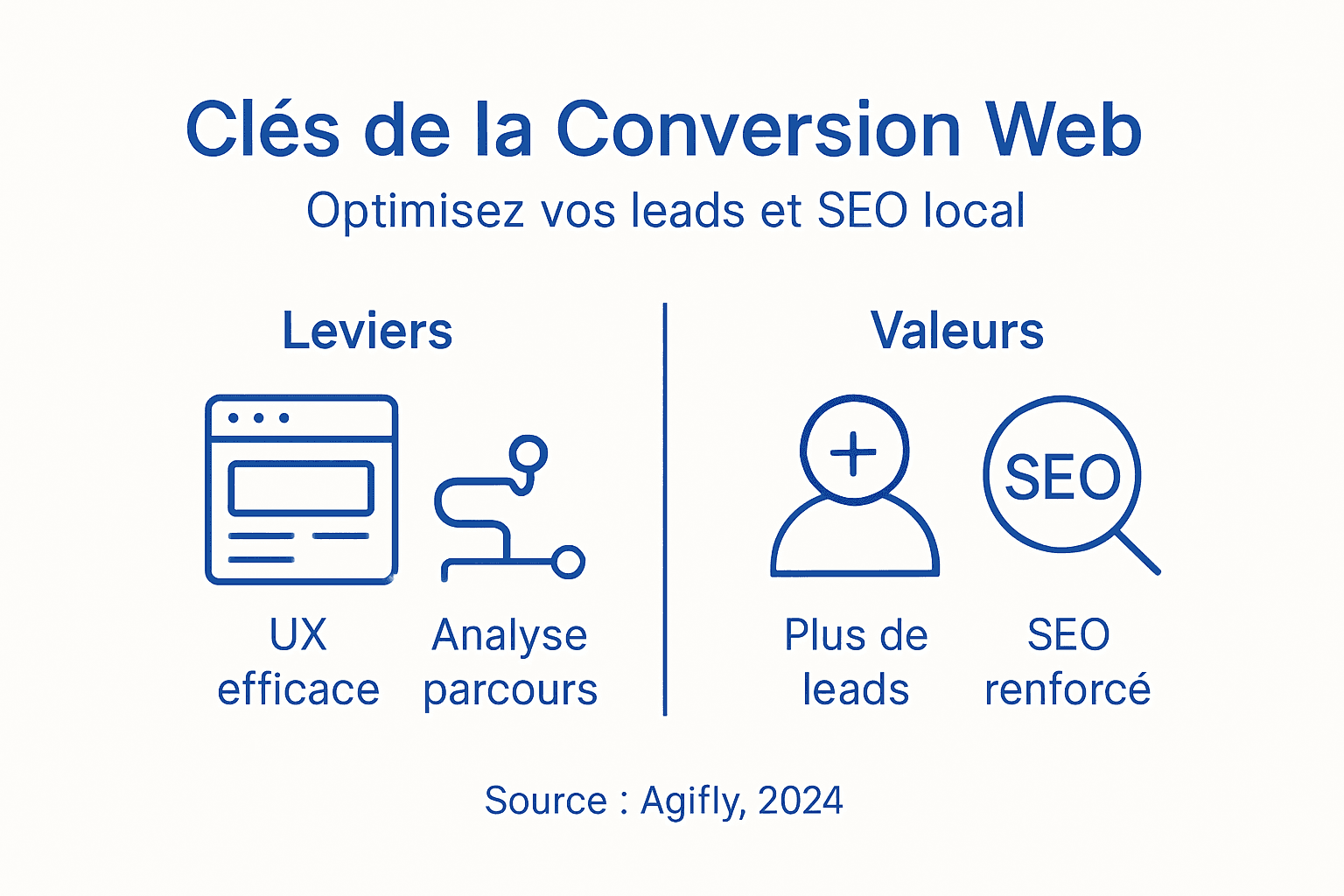
Pro tip: Set up an accurate conversion tracking system and analyze each stage of your marketing funnel to identify and eliminate obstacles to conversion.
Optimization levers adapted to the Belgian and French markets
Optimizing web conversion for the Belgian and French markets requires a nuanced approach adapted to local specificities. SEO strategies must take into account the cultural and linguistic particularities of these territories, over and above generic SEO techniques.
The main optimization levers include :
- Language adaptation
- 100% French content
- Specific regional vocabulary
- Precise translation of keywords
- Local SEO strategy
- Use of local structured data
- Optimization for geolocalized searches
- Quotes from Belgian and French directories
- Personalized user experience (UX)
- Design adapted to cultural expectations
- Intuitive conversion path
- Simplified payment process
The technical approach must also integrate elements specific to the Belgian and French markets, such as taking into account browsing habits, digital consumption preferences and local web design standards. A thorough understanding of these subtleties enables us to create truly effective conversion strategies.
Companies need to invest in in-depth analysis of digital behaviors specific to these markets, using advanced analysis tools and carrying out local user testing. This approach enables them to continually refine conversion strategies and significantly improve conversion rates.
The following table illustrates how to adapt a web conversion strategy to Belgian and French specificities:
| Strategic aspects | Belgian market | French market |
| Main language | French and Dutch | French |
| Key local platforms | YellowPages, Waze, Kapaza | PagesJaunes, Mappy |
| Purchasing habits | Preference for Bancontact payment | High credit card usage |
| Regulations | RGPD + local requirements | RGPD |
Pro tip: Perform A/B tests specifically adapted to Belgian and French audiences to optimize your conversion rates.
Link between conversion rate, UX and local SEO
The link between conversion rate, user experience (UX) and local SEO is now inseparable in modern digital strategy. Local SEO relies on a thorough understanding of the interaction between these three complementary dimensions.
The main points of convergence include :
- Impact of navigation
- Page load times
- Ease of travel
- Architectural clarity
- Performance criteria
- Relevant local content
- Mobile adaptation
- User engagement signals
- Technical signals
- Data structure
- Semantic optimization
- Geographic consistency
User experience directly influences local SEO by generating positive behavioral signals. A website that is intuitive, fast and adapted to local needs mechanically increases time spent, reduces bounce rates and improves conversion performance.

Search engine algorithms now incorporate complex UX criteria, valuing sites that offer real added value to users. This holistic approach encourages companies to think of their digital strategy in a global, interconnected way.
Pro tip: Carry out regular UX audits and systematically correlate your improvements with your SEO and conversion performance.
Common mistakes and how to avoid them
Web conversion errors can significantly compromise a company’s digital performance. SEO strategies require constant vigilance to avoid the most common pitfalls that damage visibility and conversion rates.
The main mistakes to avoid:
- Technical errors
- Sites not adapted to mobile
- Loading time too long
- Misconfigured data structures
- Content errors
- Duplicate content
- Over-optimized keywords
- Lack of local relevance
- Strategic errors
- Lack of data analysis
- Lack of understanding of user intentions
- Complex conversion path
Every mistake represents a potential brake on lead generation and SEO performance. A methodical approach involves regular audits, understanding user behavioral signals and continually adapting your digital strategy.
Optimizing web conversion requires a holistic approach, combining technical, editorial and strategic aspects. Successful companies invest in advanced analysis tools and systematic A/B testing to quickly identify and correct conversion bottlenecks.
Pro tip: Set up a monthly performance monitoring process, precisely analyzing each stage of your conversion funnel.
Turn your website into a powerful conversion lever today
Looking to improve your conversion rate while optimizing your local SEO with a flawless user experience? Every obstacle identified in the article, such as a lack of accurate data analysis or a complex conversion path, can hinder the growth of your SME in Belgium or France. At Agifly, we understand the importance of a harmonious digital strategy that combines intelligent design, scalable development and reliable hosting to create a fluid and efficient user journey.
Join https://agifly.be now and benefit from comprehensive support to convert more leads and boost your online visibility. Your digital success starts here.