

🧠 Preparing your website for 2026 and beyond: what will change (and what companies need to anticipate)
Introduction
2025 was the year when LLMs (ChatGPT, Gemini, Claude, Perplexity) became widespread.
But 2026 and 2027 will see an even more profound upheaval in the way users search, compare, validate and buy.
We are entering an IA-firstbuilt around 4 mutations:
- Conversational search gradually replaces classic Google
- Autonomous agents make decisions for users
- AIs become navigation layers (filtering, summarizing, recommendations
Non-click” progresses the user no longer opens pages, but receives the answer
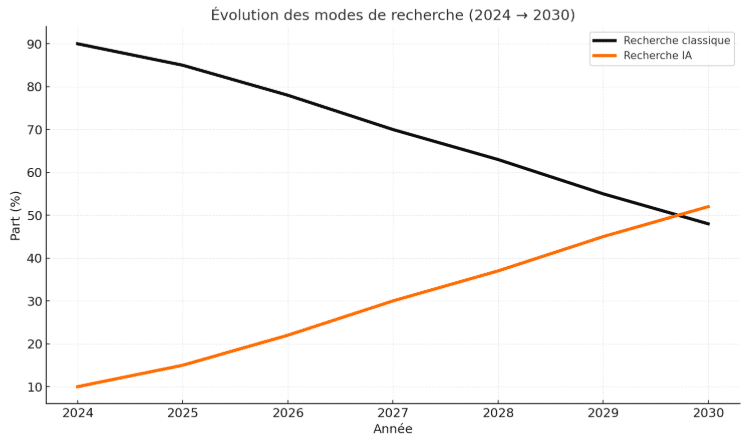
In other words:
👉 Your site doesn’t just have to convince visitors,
👉 It must convince the AIs that talk to visitors.
This article shows you how to get ready now.
⚙️ Performance remains the foundation - but the stakes are changing
In 2026, performance is no longer just an SEO criterion.
It becomes a quality signal interpreted directly by AIs.
Why?
Because AI agents (Gemini Agents, GPT Agents, etc.) test your pages:
- speed,
- stability,
- technical structure,
- code cleanliness,
- ease of data extraction.
A slow or badly structured site is no longer just penalized by Google…
It is ignored by AIs who don’t want to waste time extracting information.
What a site absolutely must guarantee in 2026-2030
- TTFB less than 100-120 ms
- loading time < 1.5 seconds
- server cache + intelligently configured CDN
- lightweight, stable pages
- clean HTML structure, semantics understood by AIs
- no noise : Unnecessary JS, intrusive pop-ups, excessive trackers
Performance becomes an algorithmic prerequisite.
🤖 AI compatibility becomes strategic (well beyond SEO)
In 2026, three phenomena will accelerate the need for an AI-first strategy:
1. Conversational search replaces the classic SERP
Users no longer “search”, they ask :
- “What’s the best service provider in…”
- “Which solution is right for me if…”
- “Explain to me the difference between…”
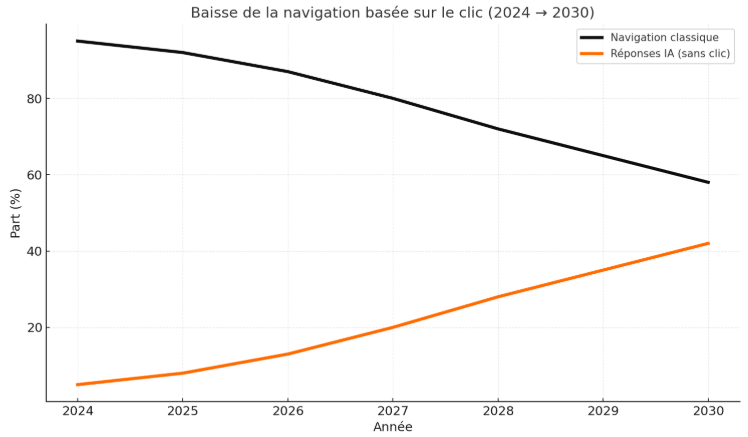
“Projection: rise in ‘no-click web’ due to AI responses.”
AIs summarize, compare and sort.
They become meta-engines.
👉 Companies must therefore optimize their content to be understoodnot just indexed.
2. Autonomous agents make decisions
2026 marks the arrival of AI agents :
- offer comparison agents,
- reservation/appointment agents,
- daily management agents (Apple Intelligence, enhanced Google Assistants),
- professional assistants who screen suppliers.
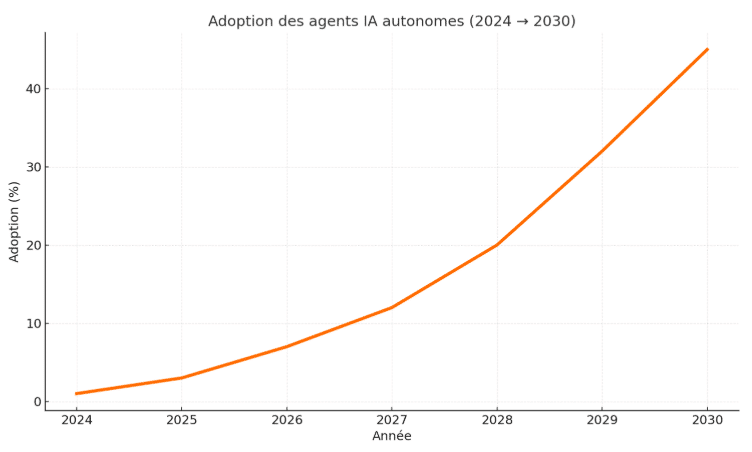
“Projected growth in the use of AI agents in everyday activities.”
These agents will never click on your pretty buttons.
They will read:
- your structure,
- your rates,
- your benefits,
- your value proposition,
- your service policy,
- your FAQ content.
A non-AI optimized site becomes invisible to agents.
3. AIs analyze your site as a document, not as a set of pages
AI models see :
📦 a corpus,
📦 concepts,
📦 entities,
📦 logical relations.
Companies need to move from a “visual” site to an “understandable” one.
This is exactly the aim of the GEO framework (see previous article).
🧩Content 2026: Clarity, Consistency and Structure
Changes in the way we write
Your site must be optimized for :
✔ humans
✔ LLM (ChatGPT / Gemini / Claude)
✔ RAG systems
✔ autonomous agents
✔ AI voice search
This requires writing:
- clearer,
- more structured,
- more “explainable”,
- more coherent,
- more segmented.
The content must meet these needs:
- Define your concepts clearly
AIs hate ambiguity. - Highlight benefits in clear, hierarchical form
No vague storytelling: understandable points. - Reducing internal contradictions
An AI will never quote an inconsistent source.
4. Give AIs what they’re really looking for: answers.
Page = Subject = Answer.
🧠 The signals your site needs to send in 2026+.
🔸 Signal 1: Readability for an IA model
Short paragraphs, clear definitions, neat structure.
🔸 Signal 2 : Mastered semantics
A uniform vocabulary throughout the site.
🔸 Signal 3 : Relationship between concepts
Let the model “map” your world.
🔸 Signal 4: Easy extraction
An agent needs to be able to spot your prices, your offers, your services.
🔸 Signal 5: Digital reputation
AIs are increasingly evaluating :
- external consistency,
- web quotes,
- confidence signals.
🚀 What you need to put in place before 2027
✔ Performance & stability-oriented technical overhaul
(server, CDN, cache, assets)
✔ AI-oriented editorial redesign
(structure, coherence, prioritization)
✔ Setting up a GEO strategy
(AI tests, citability, prompts, consistency)
✔ IA visibility monitoring
(Does your brand appear in the responses?)
✔ Preparing autonomous agents
(functional structure + extractable data)
🎯 CTA - Transform your site for 2026 and beyond
🔍 Is your site ready for AI research and autonomous agents?
Ask for our 2026+ audit :
You get :
- an IA-first analysis of your site,
- a GEO compatibility measure,
- an AI vs. competitor perception test,
- a 2026-2027 transformation plan,
- 3 immediate quick-wins to implement.
👉 [Get a free IA 2026+ audit].
Or simply send us your URL for an initial diagnosis.
❓ FAQ - 2026 and beyond
Will AIs replace Google?
Not completely, but they will exceed it in a number of ways direct answers, comparisons, recommendations, decisions.
Will AI agents replace forms?
In many cases, yes.
Sites must be structured to be used by automatic systems.
Will performance remain important?
Even more so than today: AIs value fast, stable sites.
Is GEO a fad?
No. This is the basis for AI visibility over the next few years.
Are showcase sites on the way out?
No, but their role is changing:
they become sources of truth for humans and AI.