

Web design is evolving rapidly, and SMEs in Belgium and Northern France need to adapt to stay competitive. Artificial Intelligence is emerging as a key driver, enabling hyper-contextual personalization of experiences and optimization of interfaces that adjust in real time. This article will help you decipher the major trends of 2026, so you can rethink your site and boost visitor engagement and conversion.
Table of contents
Key points
| Point | Details |
| Digital Transformation | Companies need to rethink their digital approach by integrating artificial intelligence to remain competitive. |
| Personalization and accessibility | Providing dynamic, accessible interfaces is essential to fostering user inclusion and engagement. |
| Digital Sobriety | Adopting eco-design practices not only reduces carbon footprints, but also improves brand image. |
| Cybersecurity | Investing in cybersecurity solutions and training teams is crucial to protecting sensitive data and achieving digital resilience. |
Defining web design trends 2026
Web design in 2026 marks a radical transformation, driven by technological evolution and user expectations. French companies must now rethink their digital approach to remain competitive in a rapidly changing digital ecosystem.
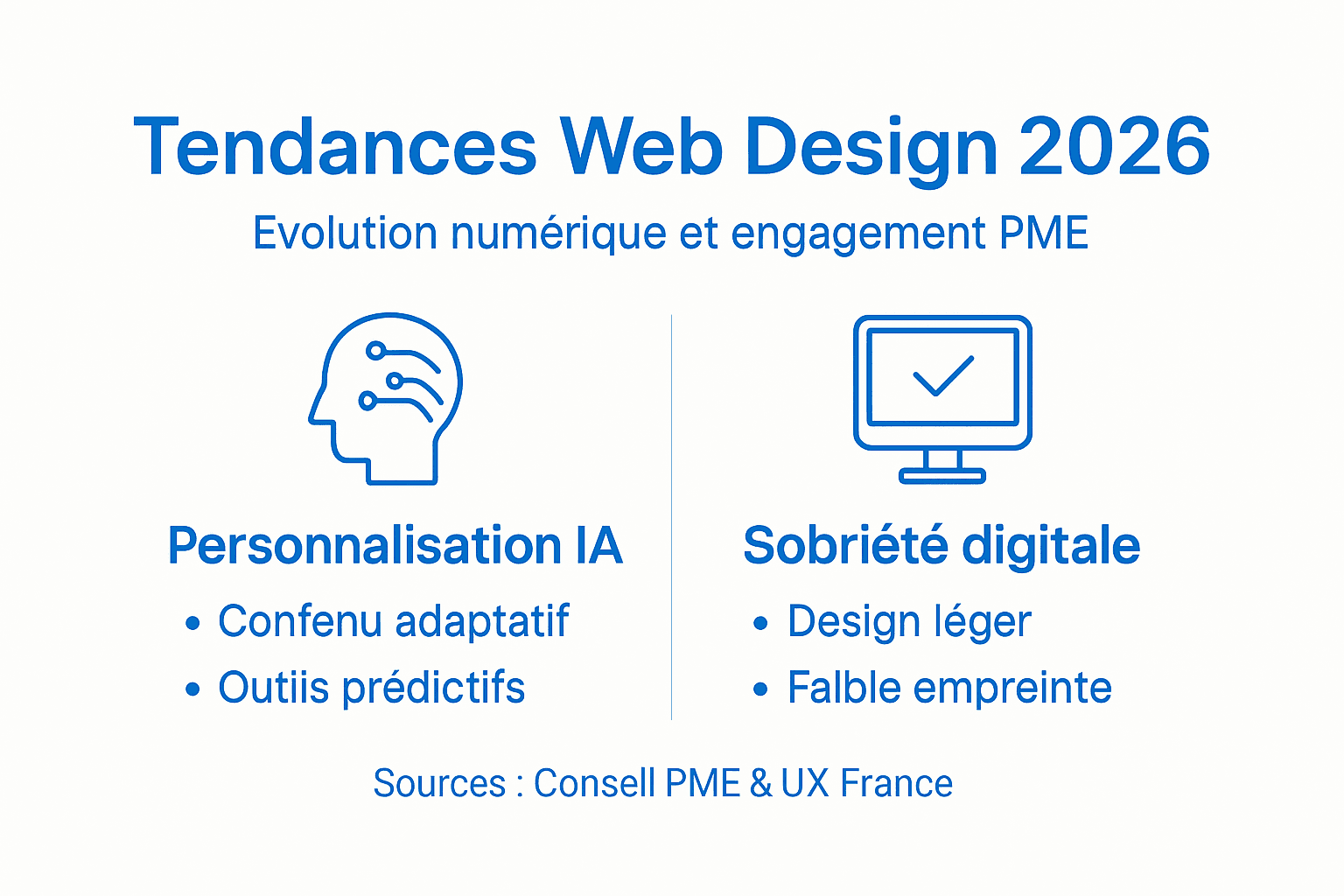
Artificial intelligence is becoming the central driver of this revolution, profoundly redefining the user experience. The evolution of digital interfaces revolves around several strategic axes:
-
Hyper-contextual personalization
-
Dynamic interface adaptability
-
Native AI integration
-
Enhanced accessibility
-
Optimizing the user experience
The companies that understand and anticipate these technological changes will be those that succeed in creating truly immersive and intuitive digital experiences. The main trend lies in the ability to offer interfaces that instantly adapt to the specific needs of each user.
This transformation is taking place at a time when technological innovation is becoming a decisive factor in competitiveness. Websites are no longer simple showcases, but dynamic, intelligent ecosystems, capable of responding in real time to user expectations.
Pro Tip: Invest now in adaptive design and AI integration skills to stay at the forefront of digital innovation.
Here is a summary of the impact of the major web design trends of 2026 on French companies:
| Key trend | Major asset | Main business challenge |
| AI personalization | Differentiated user experience | Increased loyalty |
| Immersive interfaces | Optimized sensory engagement | Brand enhancement |
| Digital sobriety | Carbon footprint reduction | Responsible image and cost savings |
| Enhanced accessibility | Inclusion of all users | Compliance and market extension |
Personalization, AI and dynamic content
Web personalization is undergoing an unprecedented technological revolution, with artificial intelligence becoming the central driver of the user experience. French companies are now able to create dynamic interfaces that instantly adapt to the individual needs of each visitor.
The optimization of behavioral data now enables ultra-precise audience segmentation. The main features of this intelligent personalization include :
-
Predictive behavior analysis
-
Real-time contextual recommendations
-
Dynamic interface adaptation
-
Granular content personalization
-
Hyper-customized user paths
Artificial intelligence is radically transforming the way companies interact with their customers. It no longer simply collects data, but interprets and uses it to create truly unique and relevant experiences.

This approach also raises important ethical issues. Personalization processes must now incorporate transparency and consent mechanisms, ensuring that data use remains respectful of users’ privacy.
Pro Tip: Invest in AI tools that offer not only advanced personalization, but also robust mechanisms for protecting personal data.
Immersive interfaces and digital sobriety
Web design in 2026 is at the crossroads of two paradigms: technological innovation and environmental responsibility. Digital interfaces are evolving towards more immersive experiences, while integrating principles of digital sobriety.
Immersive technologies are transforming user interaction by offering multisensory environments that go beyond the traditional limits of the web. Their main features include :
-
Contextual augmented reality
-
Multi-sensory interaction
-
Dynamic interface adaptation
-
Minimizing cognitive load
-
Enhanced energy efficiency
This new approach means completely rethinking the architecture of digital interfaces. The aim is no longer simply to create spectacular experiences, but to guarantee minimal environmental impact.
Digital sobriety is becoming a strategic imperative for companies wishing to reduce their digital carbon footprint. Developers must now integrate eco-design mechanisms right from the initial design phase.
Pro tip: Choose frameworks and technologies that reduce the energy consumption of your interfaces while maintaining an optimal user experience.
Accessibility and regulatory requirements in the EU and France
Digital accessibility is becoming a major strategic issue for French companies in 2026, going beyond mere regulatory compliance to become a genuine lever for inclusion and digital performance.
The RGAA regulatory framework now imposes strict web accessibility standards. The main requirements include :
-
Keyboard navigation
-
Compatibility with assistive technologies
-
Adapted multimedia content
-
Conforming visual contrasts
-
User-friendly interface
Every company must therefore rethink its digital approach to guarantee a universal user experience, whatever the disability situation. This transformation implies a complete overhaul of web design practices.
The European directive on digital accessibility significantly strengthens legal obligations. Penalties for non-compliance can now represent up to 5% of annual sales, transforming the accessibility of a recommendation into a crucial economic necessity.
Pro tip : Carry out a complete audit of your website and invest in dedicated digital accessibility training for your development teams.
Optimize performance, engagement and conversion for SMEs
Digital transformation represents a crucial strategic lever for French SMEs, going beyond simple technological modernization. It is now a question of rethinking the digital approach as a whole, in order to generate value and improve the company’s overall performance.
The digital transformation of SMEs involves a number of strategic areas for optimization:
-
Business process automation
-
Personalizing customer interactions
-
Improving digital visibility
-
Precise monitoring of performance indicators
-
Continuous adaptation to technological developments
Every digital investment must be seen as a lever for competitiveness, in line with the company’s specific characteristics and resources. The key is to adopt a progressive, pragmatic approach.
The impact of digital tools on SME performance has now been clearly demonstrated. Successful companies are those that integrate a culture of continuous learning and agile transformation.
Professional advice: Carry out a precise digital diagnosis of your company and define a step-by-step transformation plan, prioritizing high-ROI investments.
Risks, common mistakes and best practices
French SMEs are facing growing digital challenges, requiring a strategic and proactive approach to risk management. Digital transformation means understanding and anticipating potential vulnerabilities to ensure business resilience.
Managing digital risks requires constant vigilance. The main mistakes to avoid include :
-
Underestimating cybersecurity threats
-
Lack of strategic planning
-
Excessive dependence on external suppliers
-
Lack of team training
-
Neglect of security updates
SMEs need to develop an integrated and dynamic cybersecurity culture, going beyond traditional passive protection approaches.
Cybersecurity practices are becoming a major strategic issue. Companies need to put in place comprehensive protection systems, including regular training, advanced detection tools and incident response protocols.
Pro tip : Invest in a comprehensive security audit and regularly train your teams in the latest cyber-defense practices.
Understand the differences between accessibility, performance and cybersecurity for your digital strategy:
| Aspect | Main objective | Risk in case of negligence |
| Accessibility | Providing a universal experience | Audience loss and sanctions |
| Web performance | Conversion and customer satisfaction | Decrease in sales |
| Cybersecurity | Protection of sensitive data | Information leakage, litigation |
Adopt web design trends 2026 to transform your SME
Faced with the crucial challenges of AI personalization, responsible immersive interfaces and enhanced accessibility, your SME needs a partner capable of transforming these ambitions into concrete, high-performance digital solutions. These challenges call for intelligent design and scalable development to support your growth, while optimizing user experience and reinforcing security.
Don’t let these trends run up against technical or strategic limitations. Explore our services at https://agifly.be and start boosting your SMB’s customer engagement right now with a smart design tailored to your real needs. Get a head start and give your business the visibility and performance it deserves.
Frequently Asked Questions
What are the key web design trends for 2026?
Key trends include hyper-contextual personalization, dynamic interface adaptability, native AI integration, digital sobriety and enhanced accessibility.
How does artificial intelligence impact the user experience?
Artificial intelligence makes it possible to create dynamic interfaces that adapt in real time to the specific needs of each user, making experiences more relevant and personalized.
Why is digital sobriety important in 2026?
Digital sobriety reduces the carbon footprint of companies while improving their responsible image. It involves optimizing resources to minimize the environmental impact of digital interfaces.
What accessibility requirements must companies meet?
Companies must comply with strict web accessibility standards, including keyboard navigation, compatibility with assistive technologies and compliant visual contrasts to ensure an inclusive user experience.